


Government
BREAKING THE LAW
There are three big areas where governments violate open-meeting law:
-
Closed meetings
-
Agendas
-
Rolling quorums

Did you know ...
When OMA is violated, it's the individual who broke the law, not the government they work for, that pays the fine
Closed meetings
handled badly
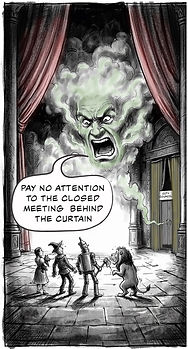
One of the most common violations happens when public bodies close a meeting without clearly stating two things: 1.The reason the meeting is being closed 2.The subject they will be discussing The law requires both — and it requires specificity. There are about 10 allowed reasons to close a meeting. A public body has to pick one and describe the topic with enough detail that the public understands what’s happening. That’s where things break down. Saying “limited personnel matters” isn’t enough. It should be something like: discussion of possible disciplinary action against an employee. Saying “acquisition of real property” isn’t enough. It should be: discussion of purchasing land for a new government building. Vague language defeats the point. The public has a right to know what’s happening behind closed doors. References: Reasons to close a meeting OMA Section 10-15-1(H)(1-10); rules for closing a meeting and “reasonable specificity” OMA Section 10-15-1(I)(1-2)
Agendas: too late,
too vague
The simplest rule about meeting agendas is the one violated most. It says an agenda be posted to the public body’s website three days before a meeting. To follow by the rule, you just look at the meeting time and count backwards consecutive 72 hours, not business hours. So, you include Saturdays, Sundays and holidays. If a meeting is at 9 a.m. Monday, the agenda must be posted by 9 a.m. Friday. Simple, right? Yet agendas are often posted late — sometimes the day before or even the morning of a meeting. We have seen government entities do this so the public doesn’t know when a controversial topic is being discussed. A meeting agenda not only tells the public what their elected officials are doing, it guarantees the government doesn’t operate in secret. The next big agenda issue: vague description of items. Agendas must describe the items to be discussed with "reasonable specificity" so the public knows what’s being discussed. So, it’s not enough for the agenda to only give a category such as "new business" and "other business." It must list the items for discussion under that category. And one last thing: If it’s not on the agenda, it can be discussed, but there can’t be a decision. References: Agenda requirements, OMA Section 10-15-1(F)

Rolling quorums,
secret consensus
A rolling quorum is how a public body meets without “meeting.” One member talks to another. Then another. Then another — through calls, texts, emails, or hallway chats — until the majority reaches a decision. It’s a secret meeting held in slow motion. No single conversation involves a quorum. But together, they add up to one. By the time the public meeting happens, the decision is already made. The Open Meetings Act says that no matter how slowly or informally a quorum reaches a decision, if it happens outside a properly noticed public meeting, it's a violation. You might suspect a rolling quorum was at play when a controversial item comes up on the agenda and the members of the public body vote quickly and unanimously, then move on. The whole point of open meetings law is so when government officials deliberate, the public gets a seat at the table. A rolling quorum pulls that table away one conversation at a time. References: The phrase “rolling quorum” is never used in the Open Meetings Act; the section cited is 10-15-1(B)

Most Common Questions About Open Meetings
DO I HAVE THE RIGHT TO SPEAK AT PUBLIC MEETINGS? No. New Mexico’s Open Meetings Act (OMA) gives you the right to attend and watch government meetings. It ensures decisions are made in the open. But it does not give you the right to make comments. Some states guarantee that right. New Mexico does not. Here, you can attend and observe, but you can only speak if the public body allows it. Many people assume the First Amendment gives them a right to speak at meetings. It doesn’t. The First Amendment protects your speech from government censorship or punishment. It does not require the government to give you a chance to speak at every meeting. But if a public body does allow public comment, the First Amendment kicks in, meaning what you say is protected as long as you follow the public body’s rules. So: • They can set reasonable rules — like time limits, sign-ups, or topic restrictions • But they cannot treat speakers unfairly or block certain viewpoints Many public bodies allow public comment because they want to hear from the community. But if they limit comment — or don’t allow it at all — that alone is not a violation of the law.
WHO HAS TO FOLLOW THE OPEN MEETINGS ACT? The Open Meetings Act applies to public bodies. A public body is any board, council, commission, committee, or similar group of government officials that makes decisions or discusses public business. The law typically applies to: • City councils and county commissions • School boards • State boards and commissions • Committees and subcommittees of those bodies WHAT DOES NOT COUNT AS A PUBLIC BODY? Not every group connected to government is a “public body.” The Open Meetings Act generally does not apply to: • Staff meetings Meetings made up only of employees that do not have decision-making authority. • Individuals acting alone A single official — like a mayor, superintendent, or agency head — acting independently is not a public body. • Groups with no authority or influence Informal groups that do not make decisions, do not direct actions, and do not play a meaningful role in shaping public policy. • Purely social gatherings Events where officials are present but are not discussing public business.
WHAT KINDS OF MEETINGS HAVE TO BE OPEN TO THE PUBLIC? All meetings that must follow the Open Meetings Act have two key elements: 1. A quorum of members is present Enough members are there to legally conduct business (usually more than half of the full membership). 2. Public business is being discussed Members are discussing, deciding, or taking steps toward a decision about government actions, policies, or operations. Essentially, if government officials are gathered in enough numbers to act, and they’re talking about public business, it’s a meeting and it must follow the Open Meetings Act. The section of the law that deals with this is 10-15-1(B). But just because a meeting must follow the Act, it doesn’t mean that meetings are automatically open to the public. The Open Meetings Act allows public bodies to hold closed meetings, away from the public, in specific situations. These exceptions are listed in Section 10-15-1 H.
CAN GOVERNMENT OFFICIALS MEET BEHIND CLOSED DOORS? Yes — but only in limited situations. The Open Meetings Act allows public bodies to close part of a meeting, called an executive session or closed meeting, for specific reasons, which are listed in Section 10-15-1 H. These typically include: • Personnel matters (like hiring or discipline) • Certain legal discussions with an attorney • Limited real estate or bargaining matters Public bodies cannot go into a closed session just because a topic is sensitive or controversial. They also cannot make final decisions behind closed doors. Any vote or official action must happen in an open meeting. The exception to this is if the public body decides to file its own lawsuit. There is no stipulation that it must vote on this in an open meeting. Before closing a meeting, the public body must: • State the specific legal reason for the closed session • Limit the discussion to that topic Closed meetings are the exception—not the rule. Most government business must still happen in public.
WHAT IS A QUORUM? A “quorum” is defined as “the minimum number of members of a public body that must be present to conduct public business.” But this definition doesn’t give a specific number of members that must be present. So, individual governments must set that number. Most often in New Mexico, a quorum means the majority of the full membership. In simple terms, that means more than half of the members of a public body must be present. This is sometimes described as “50% plus one.” Examples: If a school board has 10 members, a quorum is 6. Or If a city council has 9 members, a quorum is 5. This is also what most local governments use. However, some state laws and local ordinances set different requirements, such as requiring that two-thirds of members be present for a quorum. To figure out what quorum definition a specific public body uses, start by checking the public body’s code, charter, or rules. You can usually find these online. If they don’t list a specific number, it usually means the public body follows the “majority of members” quorum rule.
DOES IT COUNT IF OFFICIALS ARE EMAILING OR TEXTING? It can. The Open Meetings Act is not limited to in-person meetings. Emails, texts, or other messages between members of a public body can also violate the law. When the majority of members have a series of smaller, private meetings or conversations, such as by email, phone call, or text, where they talk about or decide on public business, it’s called a rolling — or walking — quorum. The conversation happens in steps — one member talks to another about a certain topic, who talks to another about the same topic, and so on — until enough members have been involved to equal a quorum. Even though the group was never all together, the discussion can still move ideas forward or build agreement outside of a public meeting. That’s what makes it illegal. While this is a violation of the Open Meetings Act, the law itself never mentions rolling quorums. Section 10-15-1(A) is used to explain why passing notes during a meeting is a problem and Section 10-15-1(B) is what is cited in regard to rolling quorums. It’s important to note that not all emails or texts between members of a public body are a problem. For example, scheduling meetings, sending out information without discussion, and one-on-one conversations without the intent of building a quorum on the topic are all fine.
When Leaders Meet, You Have Rights
Click each line to learn more
HOW TO SUBMIT an open meetings complaint
The AG's office receives complaints from all over the state, so the review process is not quick and often takes up to 3 months.
PLEASE BE PATIENT
The New Mexico Attorney General's Office is tasked with the enforcement of the Open Meetings Act.
If you believe a state or local government agency has violated the Act, gather the evidence you have — such as minutes, agendas, or meeting transcripts — and go to the Attorney General's website here.
When it asks for the type of complaint or topic, choose "Open Meetings Act (OMA) Complaint."
